Autonomous Marine Robotics Manufacturer
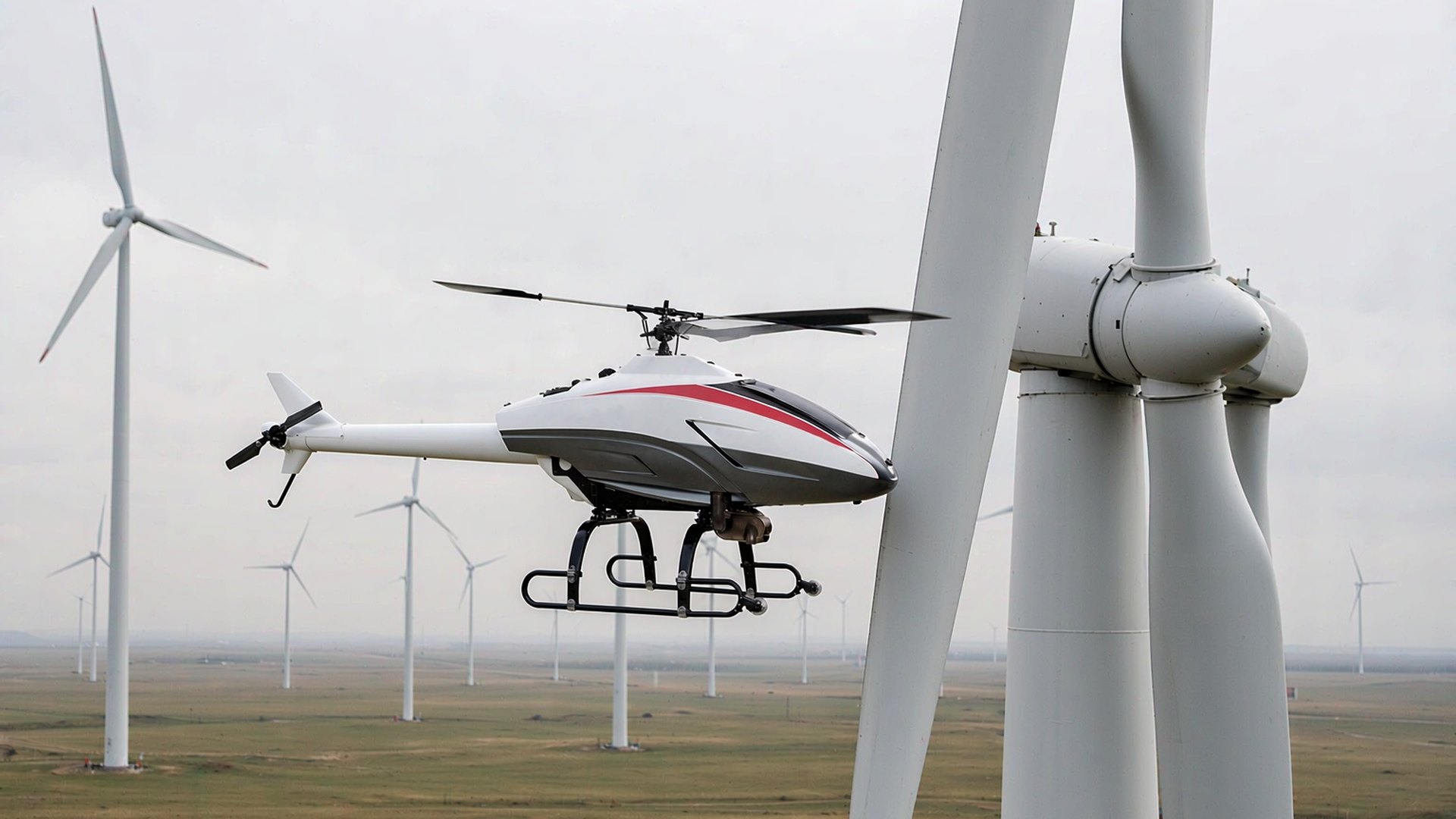

A wind turbine blade drone inspection begins as a regulatory question, not a camera question. Hovering a UAV at 8 m standoff beside a blade tip on a 150 m tower puts the aircraft roughly 165 m above the ground and within 400 ft of a structure — a combination the United States handles through 14 CFR 107.51 and a Remote ID broadcast, and Europe handles through a specific-category authorisation under Regulation (EU) 2019/947. Classify the flight wrong and the O&M window opens with no legal way to fly it.
This brief is the compliance side of that problem: what each jurisdiction calls the flight, which documents auditors ask for, and where the paperwork stops being routine.
What a wind turbine blade drone inspection is, in regulatory terms
A wind turbine blade drone inspection refers to a close-range, low-speed aerial operation flown within a few metres of a stationary rotor or tower, for the purpose of documenting surface damage, leading-edge erosion or lightning-strike evidence on the blade. It is not a mapping mission. The defining characteristics for a regulator are proximity to a structure, hover endurance, and an aircraft operated by a commercial entity for a commercial client.
| Jurisdiction | Typical classification | Approval path | Realistic lead time |
|---|---|---|---|
| United States | Part 107 commercial operation, structure-proximity altitude provision | Remote ID plus operator certificate; BVLOS or certain night work needs a waiver | 2–6 weeks |
| European Union | Specific category (STS-02, PDRA-01 or site SORA) | Operational authorisation from the national competent authority | 3–8 weeks |
| United Kingdom | UK specific category under retained Regulation (EU) 2019/947 | CAA operational authorisation, site-specific where BVLOS applies | 3–8 weeks |
| Offshore sites | Often specific category plus helicopter-landing or vessel provisions | Operator authorisation plus asset owner HSE review | 4–10 weeks |
The pattern to notice: onshore blade work is the administratively easy case, and the difficulty scales with distance from shore.
The document set to have printed before mobilisation
Auditors and asset owners ask for the same core set regardless of airframe. Print it, version it, and keep it with the flight kit; a missing page has cost more O&M days than any weather hold.
| Document | What it must show | Who checks it |
|---|---|---|
| Operator registration / certificate | Registration ID matching the aircraft label and the Remote ID serial | Authority, asset owner HSE |
| Operational authorisation or waiver | Category, conditions, altitude and standoff limits, expiry date | Authority |
| Insurance certificate | Third-party liability, policy number, territorial limits | Asset owner contract |
| Pilot competency record | Certificate, type training on the specific airframe, logbook totals | Authority, client audit |
| Maintenance log | Last rotor and engine-hour inspection, spares carried | Client audit |
| Sensor calibration certificates | Camera or thermal sensor calibration, traceable to a recognised metrology institute such as NIST | Client QA |
| Site risk assessment | Standoff distances, exclusion zones, emergency procedures, turbine shutdown contacts | Asset owner HSE |
On multi-country fleets, expect the same document to carry different names in different registries. Keep a mapping table rather than renaming files per site.
United States: Part 107, structure proximity and waivers
The useful provision is in the altitude rule itself. A visual-line-of-sight flight may operate within a 400-foot radius of a structure up to 400 feet above its uppermost limit, which legalises hover work beside most onshore turbines without any waiver at all. The constraints that remain are the ones people miss: Remote ID broadcast under Part 89, no operation over people not part of the operation, and daylight or twilight limits with anti-collision lighting.
Two cases push a US blade flight into the advanced operations space. First, the client wants the aircraft launched from one position and flown turbine-to-turbine beyond the visual line of sight — that is a waiver, with 60–90 days of lead time and a safety case the operator writes. Second, the site sits in controlled airspace, which adds LAANC authorisation to the stack.
Launch from one pad and hop 40 turbines, and the economics change as much as the paperwork.
Europe and the UK: the specific category in practice
European close-inspection work rarely stays in the open category, because the open rules cap flight at 120 m above the nearest point of ground and keep the aircraft uninvolved with any structure. Hovering beside a blade at 150 m is a specific-category operation by definition. The practical routes are the standard scenarios — STS-02 covers static inspection of industrial areas at reduced population exposure, and PDRA-01 covers a pre-defined risk assessment many authorities publish — or a site-specific SORA where the wind farm sits near housing.
The UK runs a retained version of the same regulation, and the UK CAA drone pages publish the authorisation routes and the application forms in one place. British onshore fleets therefore reuse most of the EU paperwork; the registration and marking requirements differ enough that re-reading them per fleet is worth the hour.
One honest caveat: standard scenarios assume a defined standoff from uninvolved people. A turbine beside a public footpath falls outside STS-02’s assumptions, and the application becomes site-specific whether anyone planned for it or not.
Remote ID and electronic conspicuity
Both rule sets converge on the same idea: the aircraft broadcasts who and where it is. In the United States the requirement is the Part 89 Remote ID rule, satisfied either by a built-in module or an add-on broadcast unit. In the EU it is direct remote identification under Regulation (EU) 2022/230 within the U-space framework, and the UK mirrors it. For blade work the practical consequence is procurement, not paperwork: every airframe in the fleet needs the broadcast capability verified before the first site visit, because a missing serial number is a stop-work at the gate.
Direct remote identification has a defined broadcast range and content in the US implementation guidance; European and UK texts name the same fields. Verify the module’s firmware updates the serial correctly after any avionics swap.
Ground risk, site safety and insurance
The turbine itself is the ground risk. Blade inspection happens with the rotor parked and braked, which means the asset owner’s operations team is inside the safety loop: shutdown confirmation, exclusion zone under the rotor, radio contact with the control room. The UK Health and Safety Executive guidance on wind turbine work underpins the site-side rules the operator inherits, and most asset owners write the operator into their own permit-to-work system rather than issuing a parallel one.
Insurance follows the classification. European specific-category authorisations presume third-party liability cover, and US contracts typically specify a minimum figure; the certificate belongs in the printed set from the table above, not in an email attachment the site manager cannot open.
Flown correctly, the drone is the safest person on site — no rope access, no climbing. That is the argument that sells the method to HSE departments.
Where the paperwork gets harder
Offshore is the case that breaks the routine. A transfer by vessel or helicopter puts crew movements under offshore safety rules, communications run through the farm’s own systems, and a lost aircraft can mean a recovery operation rather than a walk to the fence line. Multi-jurisdiction fleets add a second layer: an authorisation issued for a German site does not travel to a Polish one, and translating one SORA into four national templates is a week of skilled work.
Plan the first offshore campaign as a 4–10 week mobilisation on paper. It is the compliance cost, not the flight cost, that decides whether offshore blade work is profitable at tender price.
FAQ: wind turbine blade drone inspection questions
Can you fly a drone next to a wind turbine under Part 107?
Yes, within visual line of sight. The structure provision allows flight up to 400 feet above a structure’s uppermost limit within a 400-foot radius, which covers hover work beside most onshore turbines. Remote ID broadcast, daylight limits and the no-flight-over-people rule still apply, and launch positions must respect site access agreements.
What category is a blade inspection flight in the EU?
Almost always the specific category, because hovering above 120 m beside a structure leaves the open category. Standard scenarios such as STS-02 or PDRA-01 cover most onshore sites; anything near housing or offshore becomes a site-specific SORA with its own authorisation.
Do you need the wind farm operator’s permission to fly?
Yes, in practice everywhere. The asset owner controls the rotor shutdown, the exclusion zone and the permit-to-work, and their HSE review is separate from the aviation authorisation. Landowner consent matters on onshore sites where the launch pad is on rented ground.
How close can a drone hover to a turbine blade?
No regulation sets the number; the risk assessment does. Experienced teams work at 8–15 m standoff for photographic documentation, tightened after the first pass is assessed. Wind gusting above roughly 9 m/s usually widens the standoff or stops the flight before any rule does.
What insurance does a drone blade inspection need?
Third-party liability cover as a baseline, written to the territorial limits of every site in the contract. European specific-category authorisations presume it, and asset-owner contracts on both continents typically specify a minimum figure with the operator named. Expect to file the certificate with the mobilisation documents.
Platforms that fit the compliance envelope
The regulation rewards an aircraft that can hold a hover in wind without drama, and the fuel-powered helicopter platform does that job with the simplest paper trail: the SakerAero J300H carries a 35 kg payload class and 90 minutes of endurance, enough for a full turbine at photographic standoff with margin for a re-shoot. Where the fleet is mixed, the JEV260 at 120 minutes covers onshore sites from a single pad, and the JEV370C bridges inspection and the mapping work on the same contract. All three sit under the unmanned helicopter and VTOL categories on the SakerAero site.
Market context is worth tracking when pricing multi-year O&M contracts; WindEurope publishes the fleet statistics that drive inspection demand.
Two earlier pieces in this series cover the neighbouring ground: the oblique photogrammetry compliance brief works through the same authorisation logic for city capture, and the coastal catapult survey field report shows what recovery planning looks like when the site has no road. For a wind turbine blade drone inspection, the aircraft is the easy half of the tender; the authorisation file is what the client is actually buying.